04 — AI Learning Platform & Agent Workspace
Chalant AI
Teaching people to manage AI by giving them a team to manage — with the judgement built in, not lectured about.
- Role
- Lead product designer
- Year
- 2025
- Focus
- AI Product Design, Information Architecture, Dashboard Design, Design System, Gamification
- Status
- Prototype
 CHALANT AI — 2025
Overview
Chalant AI is a learning platform for people who need to work with AI rather than merely read about it. Alongside courses, live sessions and voice learning sits the AI Manager Path — a simulated workspace where learners run a team of AI agents, assign real tasks, review the output and answer for the quality. I led end-to-end product design across the learner and admin experiences.
At a glance
- Role
- Lead product designer
- Ownership
- End-to-end ownership across learner and administrator experiences
- Product status
- Prototype
- Platform
- Responsive web application
- Primary users
- Learners building AI judgement; administrators running the platform
- Main focus
- Calibrated trust, human review checkpoints, dual-role product design
- Product
- Chalant AI — an AI learning platform built around a simulated agent workspace
- Scope
- End-to-end product design across the learner and administrator experiences
- Constraints
- One system serving a learner who wants to progress and an operator who runs it as a business
Deliverables
- AI agent workspace
- Review queue & confidence system
- SOP library
- Task management (Kanban, timeline, checklist)
- Export centre
- Admin analytics & insights
- Gamification system
- Design system
My contribution
I led the end-to-end product design for both sides of the platform: the learner's AI Manager Path with its team of five agents, the review queue and confidence system, the SOP library, task management and export centre, and the administrator's course builder, analytics and revenue surfaces. I designed the progression system and the single design system that keeps learner and operator inside one product rather than two.
The problem
The skill people actually need around AI is not prompting — it is management: deciding what to delegate, judging whether the result is good enough, and knowing when a confident-sounding output should be rejected. That judgement cannot be transferred by watching a video, because the failure mode being trained against is precisely the one a passive learner exhibits: accepting plausible work without checking it. So the platform had to teach through practice with consequences, while remaining a product an administrator could run as a business — which meant one system serving a learner who wants to progress and an operator who needs to see engagement, revenue and where courses are failing.
What made this hard
Quick Approve is the whole tension in a single control. The product exists to teach people not to accept plausible AI output without checking it, so a shortcut that lets them do exactly that is the obvious thing to delete. Deleting it makes the exercise dishonest: in real work the shortcut always exists, and a tool that forbids it trains compliance rather than judgement. Keeping it meant accepting that learners can take the easy path, and designing the surrounding signals — confidence score, estimated review time, SOP compliance — so that taking it is a decision they can watch themselves make. The same tension runs through the progression system: XP and streaks sustain a path measured in weeks, but rewarding throughput inside a product about careful review would teach precisely the wrong habit, which is why progression sits in the sidebar as ambient context instead of driving the work.
Research & discovery
Research status — Exploratory, product-design-led
- Who
- Learners who need to work with AI rather than read about it, and the operator running the platform as a business.
- Investigated
- What skill actually needs teaching — the finding was that it is management and judgement, not prompt writing.
- Learned
- The failure mode being trained against is accepting plausible output without checking it, which is exactly what a passive learner does.
- Changed
- The lesson became a workspace with consequences rather than a module, and Quick Approve was deliberately kept so the trade-off stays real.
- Still open
- Whether the platform actually improves calibrated trust — the central claim, and the one that most needs measuring.
- Next test
- Measure whether a learner's approval accuracy improves across sessions, and whether Quick Approve use falls as judgement develops.
Key decisions
- 01
Made the lesson a workspace. The AI Manager Path drops the learner into a team of five agents with roles, live status and current tasks — so the unit of learning is a decision made under realistic conditions rather than a module completed.
- 02
Exposed the numbers a manager would actually use. Every agent card carries accuracy, task volume, average turnaround and progress, so judging performance means reading evidence instead of trusting a vibe.
- 03
Designed the Review Queue as the heart of the product. Each submission states a confidence score, an estimated review time and whether it passed SOP compliance — three signals that together teach calibrated trust rather than blanket acceptance or blanket suspicion.
- 04
Kept Quick Approve next to full Review, deliberately. The shortcut has to exist for the trade-off to be real; a tool that forbids it teaches compliance, not judgement.
- 05
Anchored quality in written standards. The SOP Library holds versioned procedures with ownership, compliance scoring and critical alerts, and any SOP can be linked to a task — so good output means measured against something, not merely looks right.
- 06
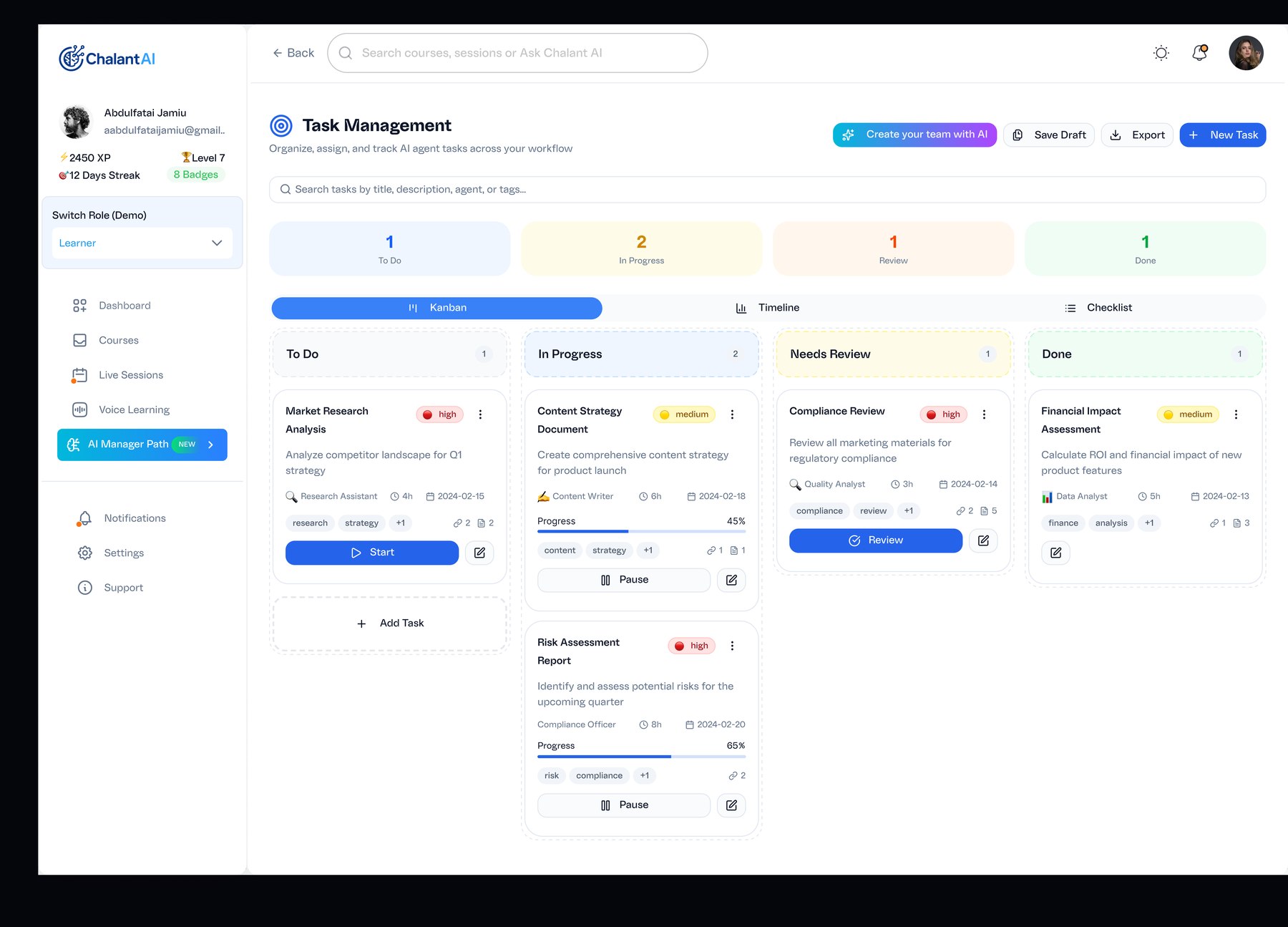
Made the human checkpoint structural. Needs Review is its own column on the task board rather than a flag, so work cannot reach Done without passing through a person.
- 07
Gave practice an artefact. The Export Center sends reports, analytics, decks and task data out as PDF, Excel, PowerPoint and JSON, so a training exercise ends in something the learner can actually use at work.
- 08
Tuned progression for a long path. XP, levels, streaks, badges and rank sustain momentum across weeks of practice, and sit in the sidebar as ambient context rather than interrupting the work.
- 09
Built one product for two roles. A role switch reveals the operator's surfaces — course builder, path analytics, plan and revenue — so learner and admin share a single design system instead of splitting into two disconnected apps.
- 10
Made analytics end in a decision. Each AI insight names the course and module, quantifies the problem, proposes a specific action and states its own confidence — modelling, in the admin product, exactly the calibrated-trust behaviour the learner product is teaching.
What changed
A learning product where the curriculum is the work itself: agents to delegate to, confidence scores and SOPs to judge against, a review step that cannot be skipped structurally, and exports that turn practice into deliverables. Learner and operator share one design system, and the same principle runs through both — surface the evidence, name the confidence, and leave the judgement with the person.
Scope & context
- Product scope
5
AI agents a learner manages, each with role, status and workload
- Product scope
2
Roles in one system — learner and administrator
- Product scope
4
Export formats — PDF, Excel, PowerPoint and JSON
- Product scope
SOP-anchored
Versioned procedures every output is reviewed against
Evidence
The human checkpoint is structural rather than advisory: Needs Review is its own column, so work cannot reach Done without passing through a person. Quality is anchored to versioned SOPs rather than to taste, learner and operator share one design system instead of splitting into two disconnected apps, and the Export Centre turns a training exercise into artefacts a learner can actually use at work.
See the design system behind this →What I would improve next
The obvious study is whether a learner's approval accuracy improves across sessions — comparing what they approve early against what they approve after working through the SOP library — and whether Quick Approve use falls as judgement develops. That would turn the product's central claim into something measured rather than argued.
With more time
I would give the agents memory of their own past corrections, so a learner can see an agent improve because of their reviews. That closes the loop the product argues for and turns reviewing from a chore into visible cause and effect.
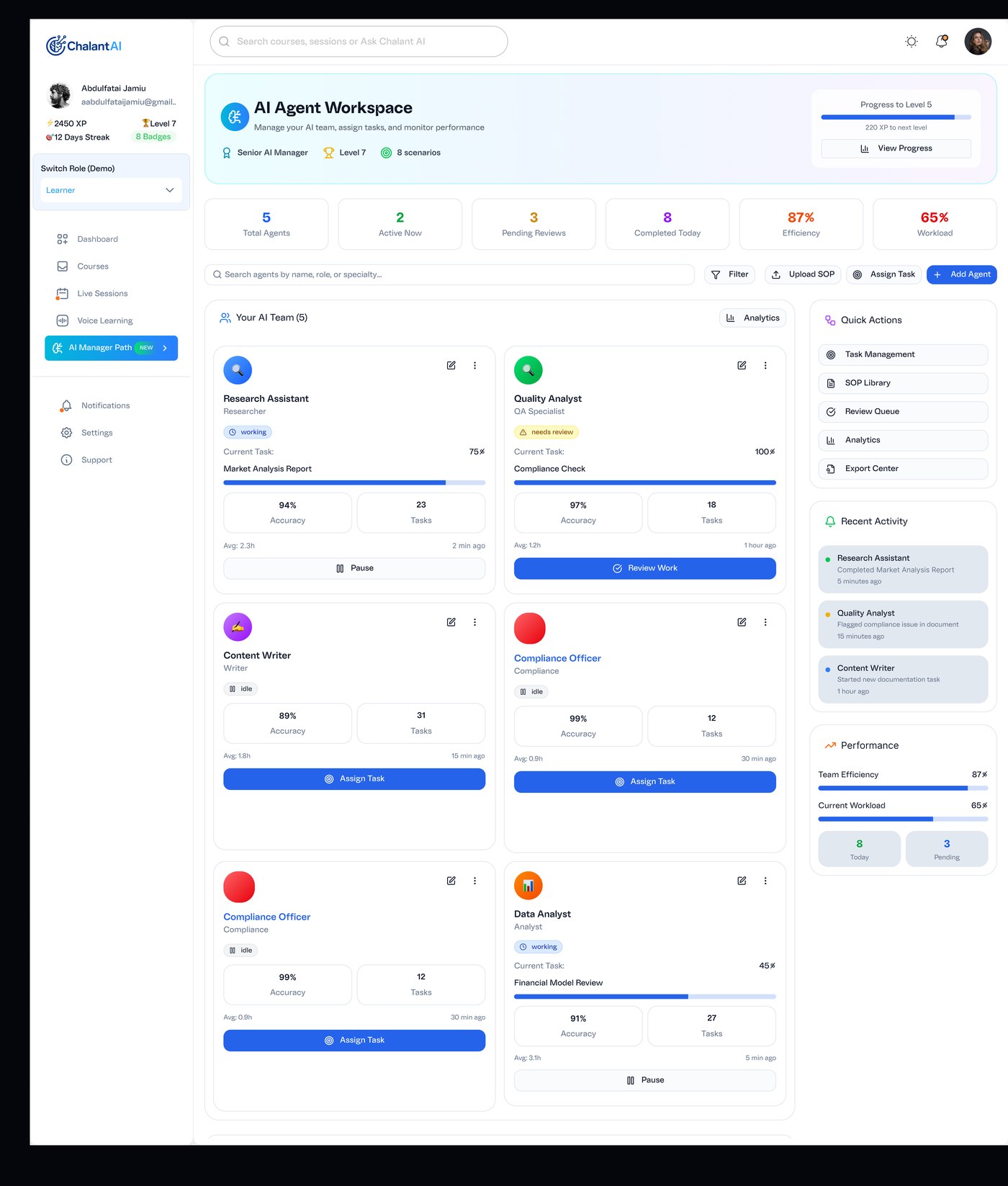
The AI Agent Workspace: five agents with role, live status, current task and progress, alongside accuracy and volume figures — the learner reads their team the way a manager reads a standup 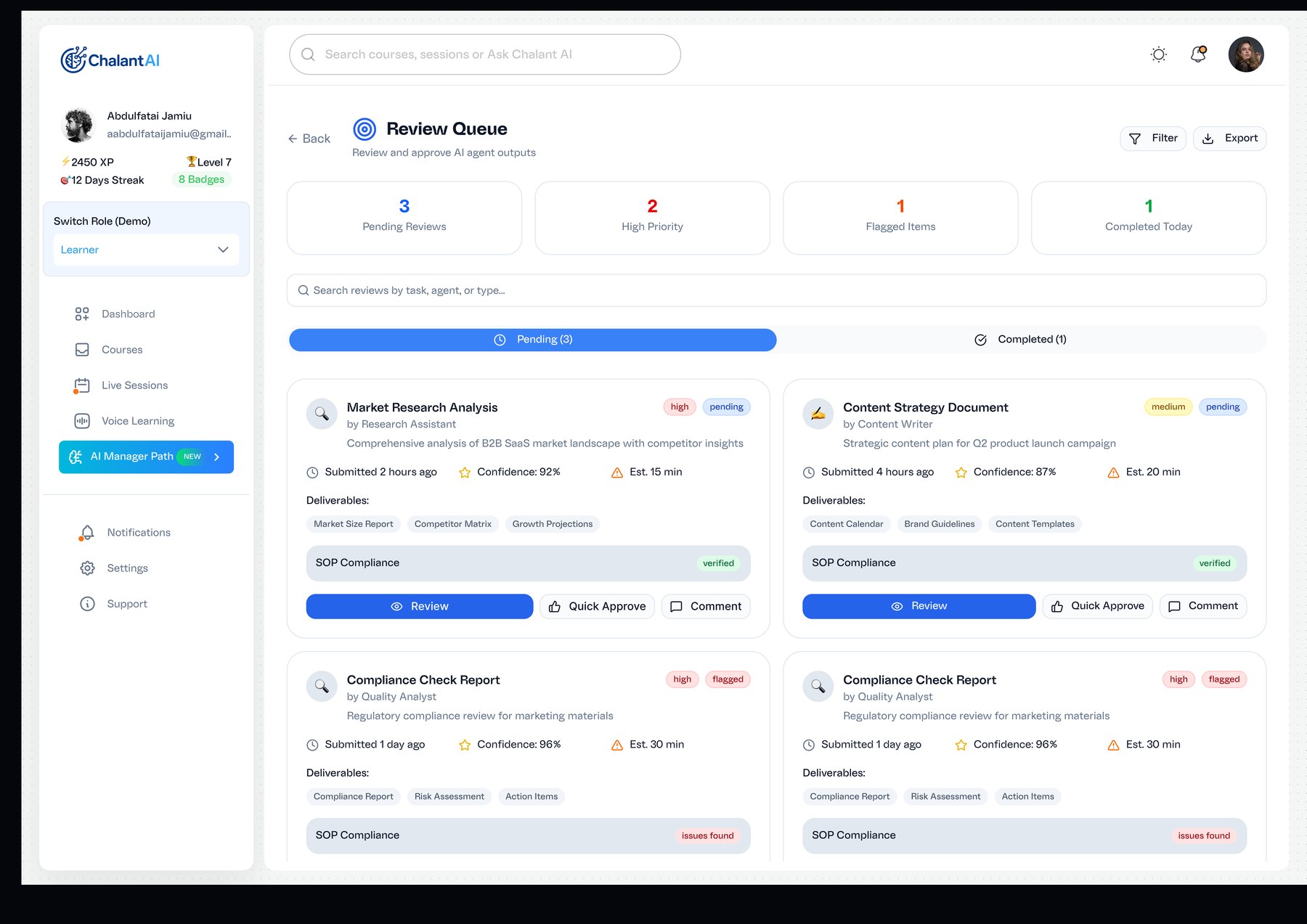
The Review Queue states each output's confidence score, an estimated review time and whether it passed SOP compliance — Quick Approve sits beside a full Review rather than replacing it 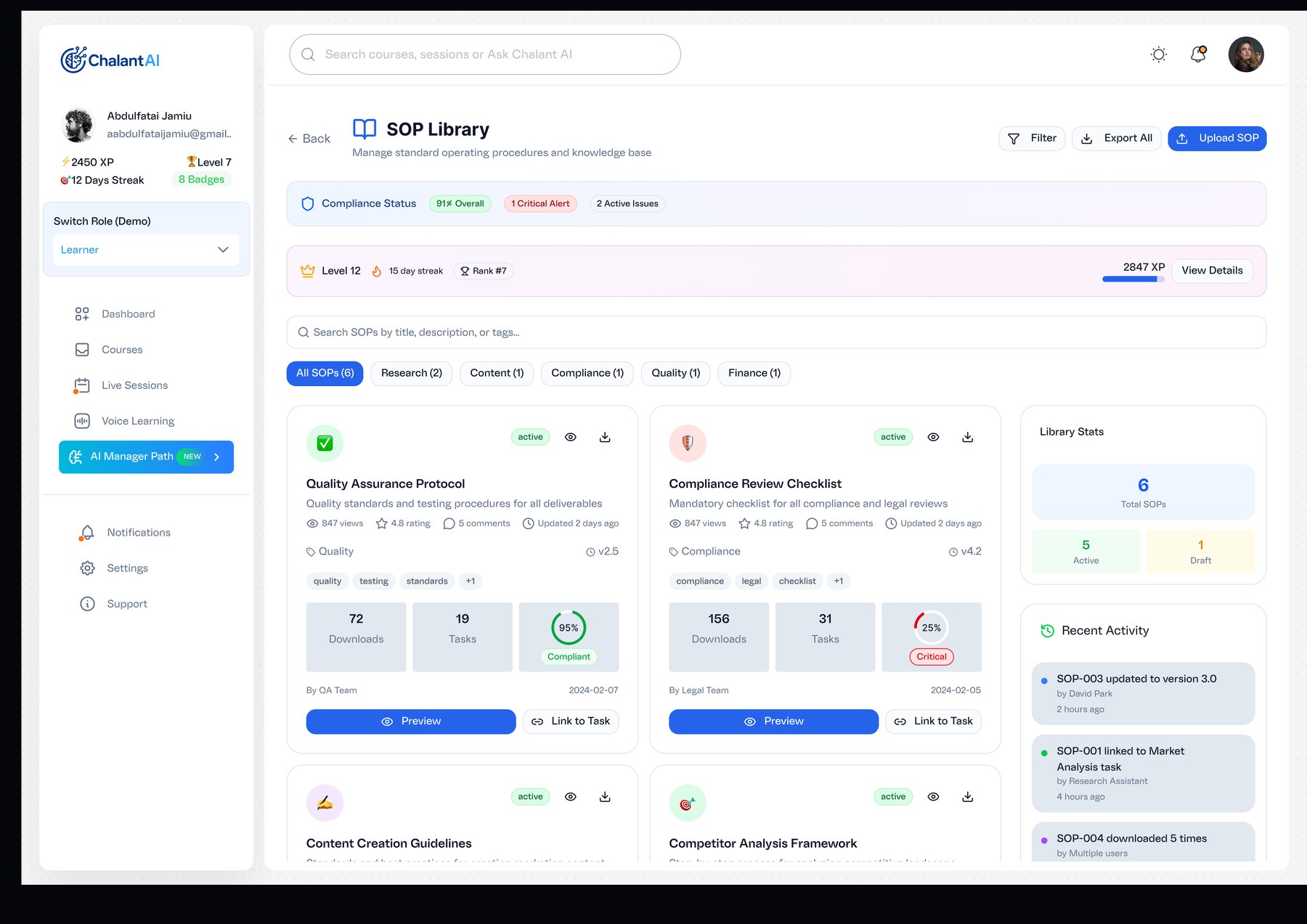
The SOP Library: versioned standard operating procedures with compliance rings, a critical alert surfaced at the top, and each SOP linkable directly to a task 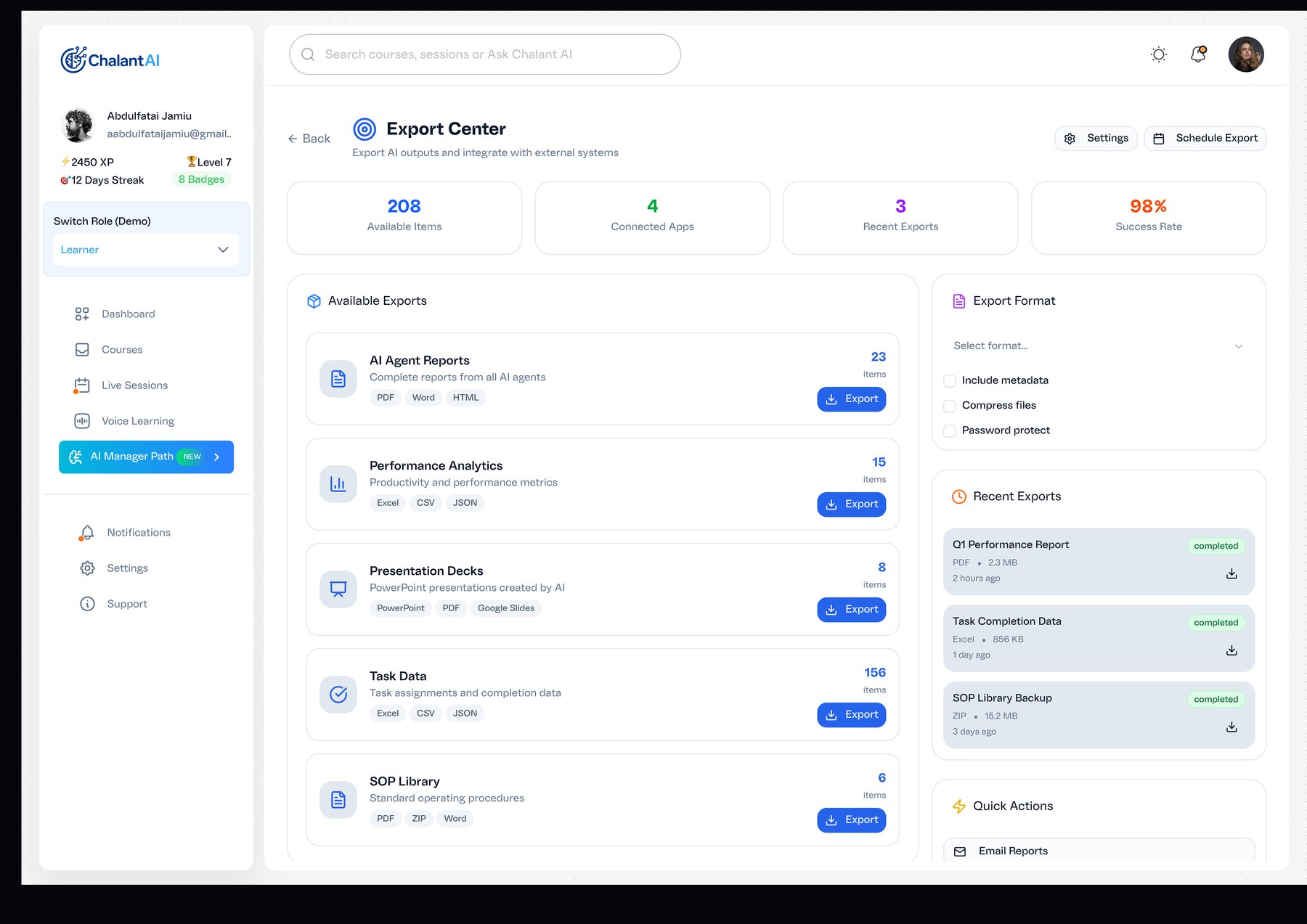
The Export Center turns practice into artefacts — agent reports, analytics, decks and task data leaving in PDF, Excel, PowerPoint and JSON 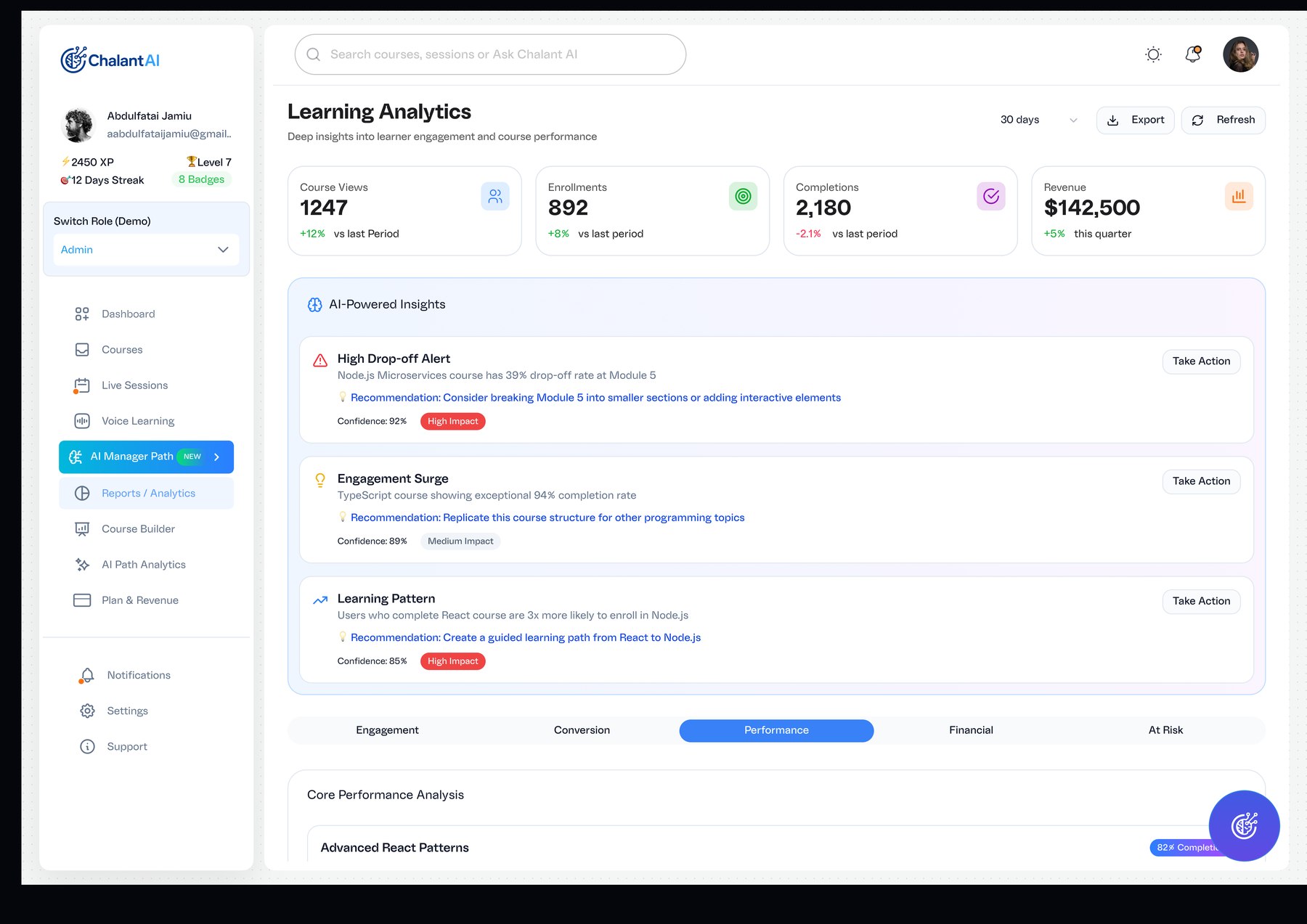
Admin analytics where each AI insight names the course and module, quantifies the drop-off, recommends an action and states its own confidence