05 — AI Fashion Platform & Artisan Operations
Kremor AI
African textiles as a design language, not a print — a generator, a storefront, and the workshop floor that turns a prompt into a garment.
- Role
- UI/UX Designer — Design & Research Lead, Kremor AI (contract, part-time)
- Year
- 2024 — 2026
- Focus
- AI Product Design, Conversational UI, E-commerce UX, Role-Based Admin, Design Systems
- Status
- Live product
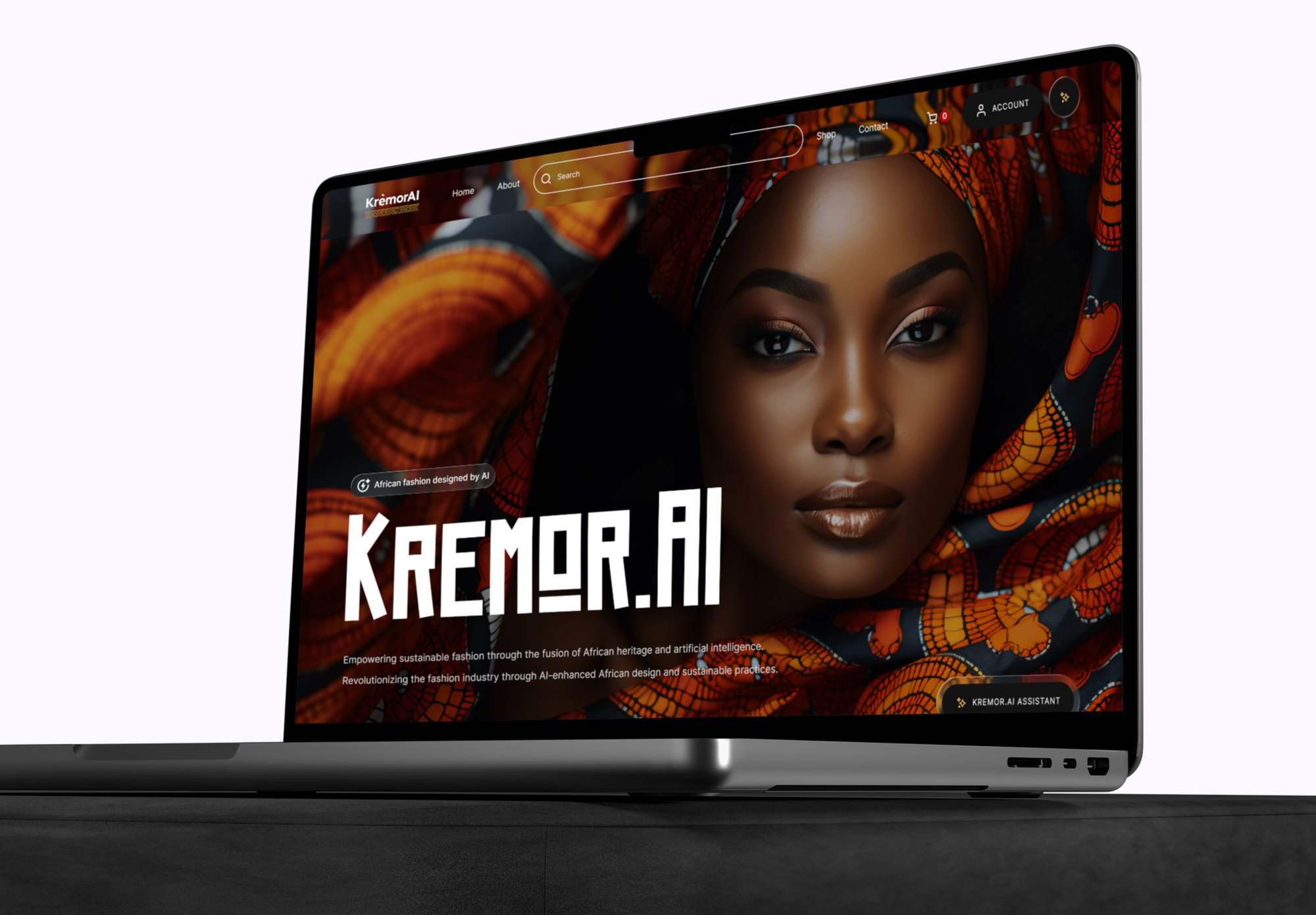 KREMOR AI — 2024 — 2026
Overview
Kremor AI is a fashion-technology platform that generates custom African clothing from a prompt and then has it made. It runs as three connected surfaces: a storefront selling AI-generated Ankara womenswear, menswear and bags; a creative workspace where a design is explored and iterated; and an admin platform where measurements, artisans, design approvals and production are managed by role. I designed all three end to end on contract from June 2024 to July 2026 — flows, interface design, AI interaction patterns and the design system — and evaluated 96+ complex AI interaction tasks to find the patterns worth keeping.
At a glance
- Role
- UI/UX Designer — Design & Research Lead, Kremor AI (contract, part-time)
- Ownership
- Design and research lead — end-to-end across three surfaces, plus AI model evaluation
- Timeline
- June 2024 – July 2026
- Product status
- Live product
- Platform
- Responsive web
- Primary users
- Customers generating and buying garments; artisans and five operational roles
- Main focus
- Generative product UX, role-based operations, prompt-to-garment workflow
- Product
- Kremor AI — AI-generated African fashion, and the operations that turn a design into a garment
- Team
- Contract engagement reporting to the founder, leading the design team
- Scope
- Storefront, generative workspace, role-based admin platform, and the design system across all three
- Constraints
- Generated designs have to be manufacturable by real tailors, and the workshop runs on five roles with different permissions
Deliverables
- AI design assistant & prompt scaffolding
- Generative workspace
- Storefront & product experience
- Order, measurement & production pipeline
- Artisan & design approval workflows
- Role-based permissions matrix
- Audit log & accountability model
- Staff & conversation management
- Design system & dev handoff
My contribution
I led the product design and the research on Kremor AI. I designed all three surfaces end to end: the storefront selling AI-generated Ankara womenswear, menswear and bags; the generative workspace where a design is explored and iterated; and the role-based admin platform covering orders, measurements, artisans, design approvals, production, messages, inventory, permissions and audit history. Separately from the product design, I worked on AI model evaluation for the platform — forensic benchmarking, dataset annotation and qualitative evaluation of LLM and generative-image output, including 96+ complex AI interaction tasks.
The problem
African fashion is usually flattened twice over. Globally it is reduced to a single decorative idea — African print — when Ankara, Aso-Oke, Adire and Kente are distinct traditions with their own rules. And in most AI tools it would be flattened again, into a style filter applied to a Western silhouette. The brief was the opposite of that: use AI to widen what someone can imagine wearing, while treating the textiles as a language rather than a texture. That created two problems. Most people cannot describe a garment they have not seen, so a blank prompt box would fail exactly the person the product exists for. And a generated image is not a dress — someone still has to take measurements, approve a design, cut fabric and sew it, which meant the creative surface was worthless unless the workshop behind it was designed with the same care.
What made this hard
Two forces pulled against each other. A generative tool is only useful to someone who can describe what they want, and the people this product exists for often cannot — they have an occasion, a feeling, a fabric they have seen somewhere, and no vocabulary for any of it. The blank prompt box is the honest interface for a generator and the wrong interface for this audience, so scaffolding had to be added without narrowing what someone is allowed to ask for. The harder constraint is physical: a generated image is not a dress. Somebody still takes measurements, approves the design, cuts fabric and sews it, which made the creative surface worthless unless the workshop behind it was designed with equal care — and that workshop involves five roles, genuinely dangerous actions like suspending an artisan or refunding a payment, and a need to reconstruct afterwards who did what.
Research & discovery
Research status — Exploratory, product-design-led, with model-evaluation work alongside
- Who
- People who want African clothing but have no vocabulary to describe it, and the artisans and managers who have to make what gets generated.
- Investigated
- Whether a blank prompt field could serve an audience that has an occasion and a feeling but no design language — and what has to exist operationally for a generated image to become a garment.
- Learned
- The honest interface for a generator is the wrong interface for this audience; and the creative surface is worthless without the workshop behind it.
- Changed
- Quick actions and phrased openers replaced the bare prompt box, and the operations platform was designed with equal care to the storefront, with dangerous actions gated and an immutable audit trail.
- Still open
- Whether the five designed roles match the roles the workshop actually runs on.
- Next test
- Test the prompt scaffolding with people who have no design vocabulary and no familiarity with the textiles, and validate the permissions matrix against how the workshop really operates.
Key decisions
- 01
Named the textiles rather than the continent. The product speaks in Ankara, Aso-Oke, Adire, Kente and Afro-fusion instead of African print, because specificity is both the respect the subject is owed and the vocabulary the generator needs to work with.
- 02
Refused the blank prompt box. The assistant opens with quick actions — generate design concepts, show style options, explore trends, create layout variations for Ankara patterns — and the home page offers openers phrased how people actually talk: I want an African vibe wear for an event. Someone with a feeling but no vocabulary still gets a first move.
- 03
Sequenced the promise the way creative confidence is built: personalised designs takes what you already know about yourself, AI-powered creativity opens options you had not considered, and unique and exclusive returns ownership of the result to you. Input, exploration, authorship — in that order.
- 04
Kept the assistant present across the whole storefront rather than parking it in a separate tool, so browsing and creating stay one activity and inspiration can be acted on where it strikes.
- 05
Designed the Workspace around iteration rather than one-shot generation. A single field — ask anything, create anything — accepts reference material and voice, and History and Marketplace sit in the top bar, so a train of thought can be resumed instead of restarted. Creative process only compounds if it persists.
- 06
Anchored the generated in the physical. Product pages state fabric, care, delivery and how this was made, so the sustainability claim is carried by facts about the garment instead of a banner over the top of it.
- 07
Designed the pipeline from prompt to finished piece as one path — orders, measurements, artisans, design approval, production board, messages, exports — so a generated design has a documented route to a tailor's hands, and craftsmanship stays in the loop rather than being replaced by the model.
- 08
Made the operating model explicit in a permissions matrix. Super Admin, Design Manager, Production Manager, Support Agent and Inventory Manager are laid against every action, with dangerous ones — suspend an artisan, cancel an order, refund a payment, override a status — marked and confirmation-gated, and always-allowed permissions shown as locked rather than quietly missing.
- 09
Made accountability legible with an immutable, read-only audit log where every entry is timestamped and attributed to the role that acted, human or system — necessary in a product where a model, an agent and a manager all touch the same order.
- 10
Designed staff changes around the customer, not the employee record. Suspending a support agent surfaces their twelve open conversations before anything else and offers reassignment — automatically by workload and availability, or by hand with each agent's active count and workload visible, and a preview of the conversation being moved.
- 11
Maintained the design system across all three surfaces — shared text and colour styles, a component page, and a Ready for Dev page — so the storefront, the workspace and the admin platform read as one product and engineering had a single source to build from.
What I explored
The working file keeps its versions rather than overwriting them: Design V1.0 and V1.1 sit alongside the admin dashboard and component pages, and an AI-proposed direction was explored as its own branch before the assistant settled into the form it shipped in. A Ready for Dev page marks what was actually handed over, which keeps the explored directions separable from the delivered ones.
What changed
One product across three surfaces that each answer a different question: can I imagine it, can I buy it, can it actually be made. The generative side is scaffolded so that people who cannot yet describe what they want still get somewhere, the commerce side grounds AI output in fabric, care and provenance, and the operations side carries a role model, a permissions matrix and an immutable audit trail sturdy enough for real orders passing between managers, support agents and artisans. All three share one design system and a documented development handoff.
Scope & context
- Product scope
3
Connected surfaces — storefront, AI workspace, operations platform
- Product scope
5
Operational roles in the permissions matrix
Super Admin, Design Manager, Production Manager, Support Agent, Inventory Manager
- Product scope
96+
Complex AI interaction tasks evaluated
AI evaluation work, distinct from the product design
- Product scope
Immutable
Audit log attributing every action to the role that took it
Evidence
Kremor AI's founder has written a reference describing the dual role — UI/UX design alongside AI model evaluation covering forensic benchmarking, dataset annotation and qualitative evaluation of LLM and generative image output — readable in full on the credentials page. 96+ complex AI interaction tasks were assessed to identify usability patterns, and the build is live. Three surfaces ship on one design system, with a Ready for Dev page marking exactly what engineering was handed.
What I would improve next
I would test the prompt scaffolding with people who have no design vocabulary and no familiarity with the textiles, because that is the audience the product is built for and the one most likely to stall at the first screen. On the operations side, I would want to know whether the permissions matrix matches how the workshop actually runs — whether the roles as designed correspond to the roles people really hold — before treating that model as settled.
With more time
I would connect the generated design to the measurement and production data properly, so a customer can see their own garment moving through the workshop rather than disappearing after checkout. The operations side already holds that state; the customer side does not surface it.
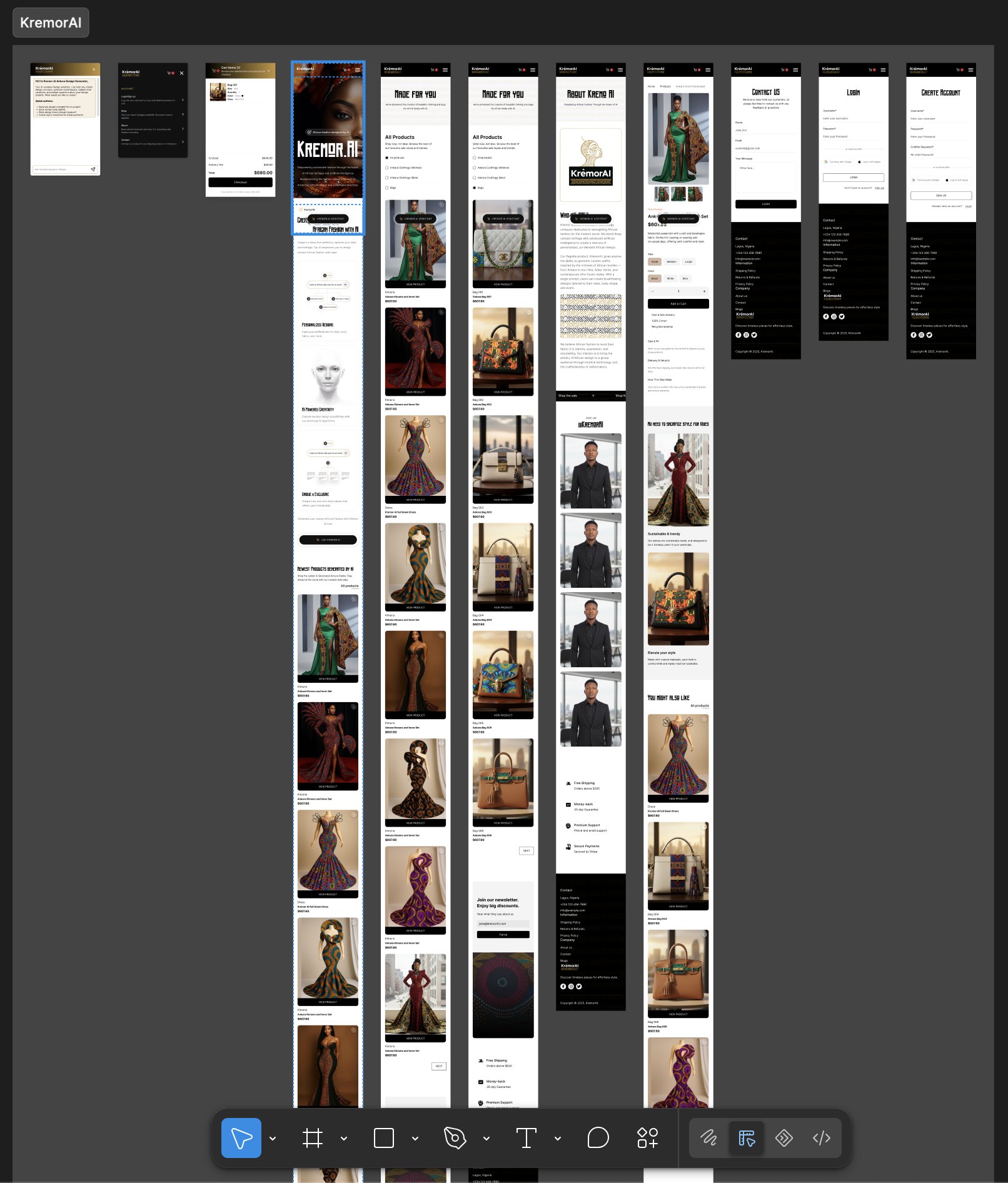
The mobile system end to end — the design assistant with its quick actions, the generative home page, shop filtered by Ankara womenswear, menswear and bags, the product detail with size, colour, fabric and how the piece was made, About, contact, login and account creation 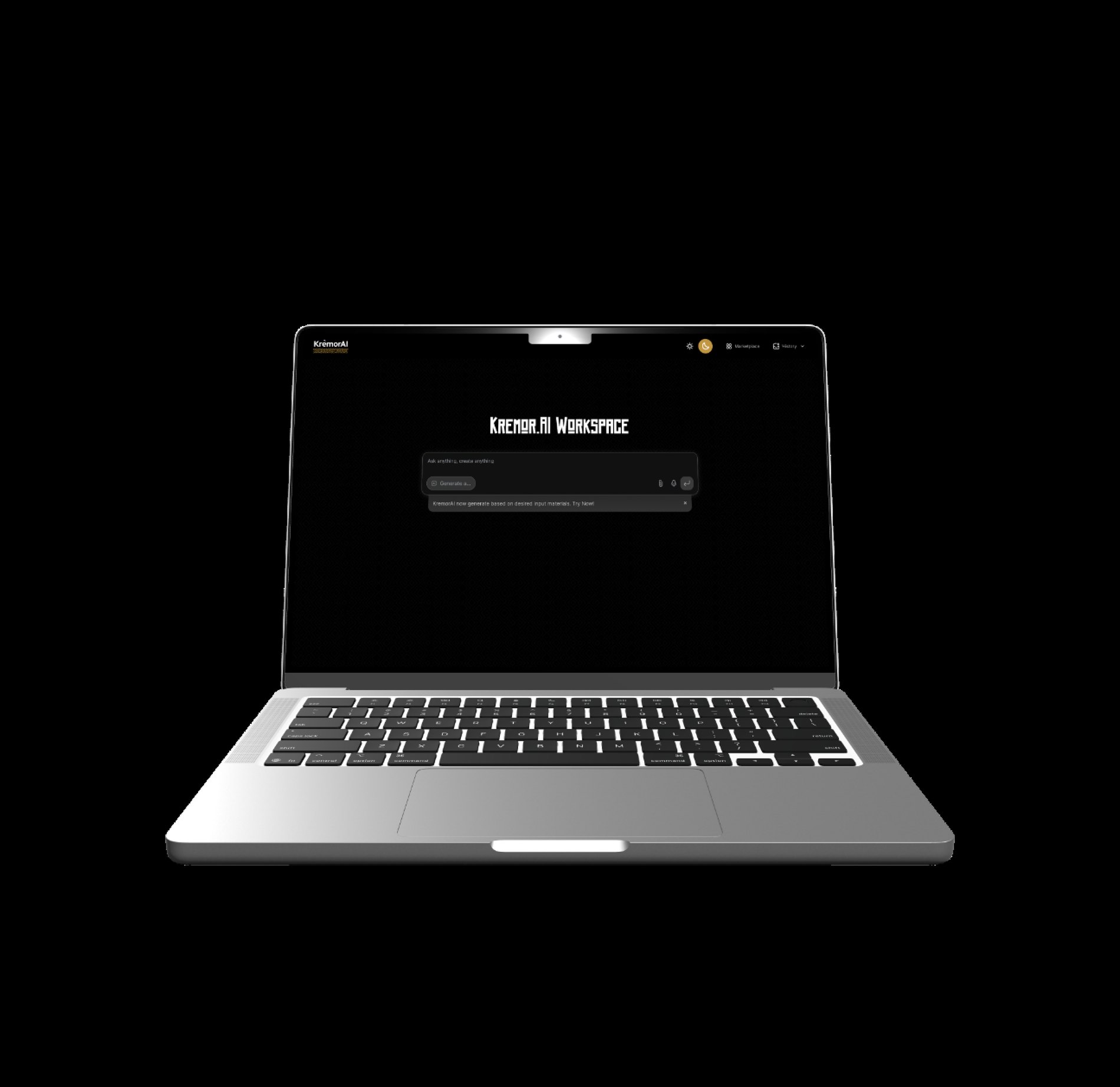
Kremor.AI Workspace: one prompt field reading ask anything, create anything, with attachment and voice input, a generate action, and Marketplace and History in the top bar — so a session of creative work can be returned to rather than restarted 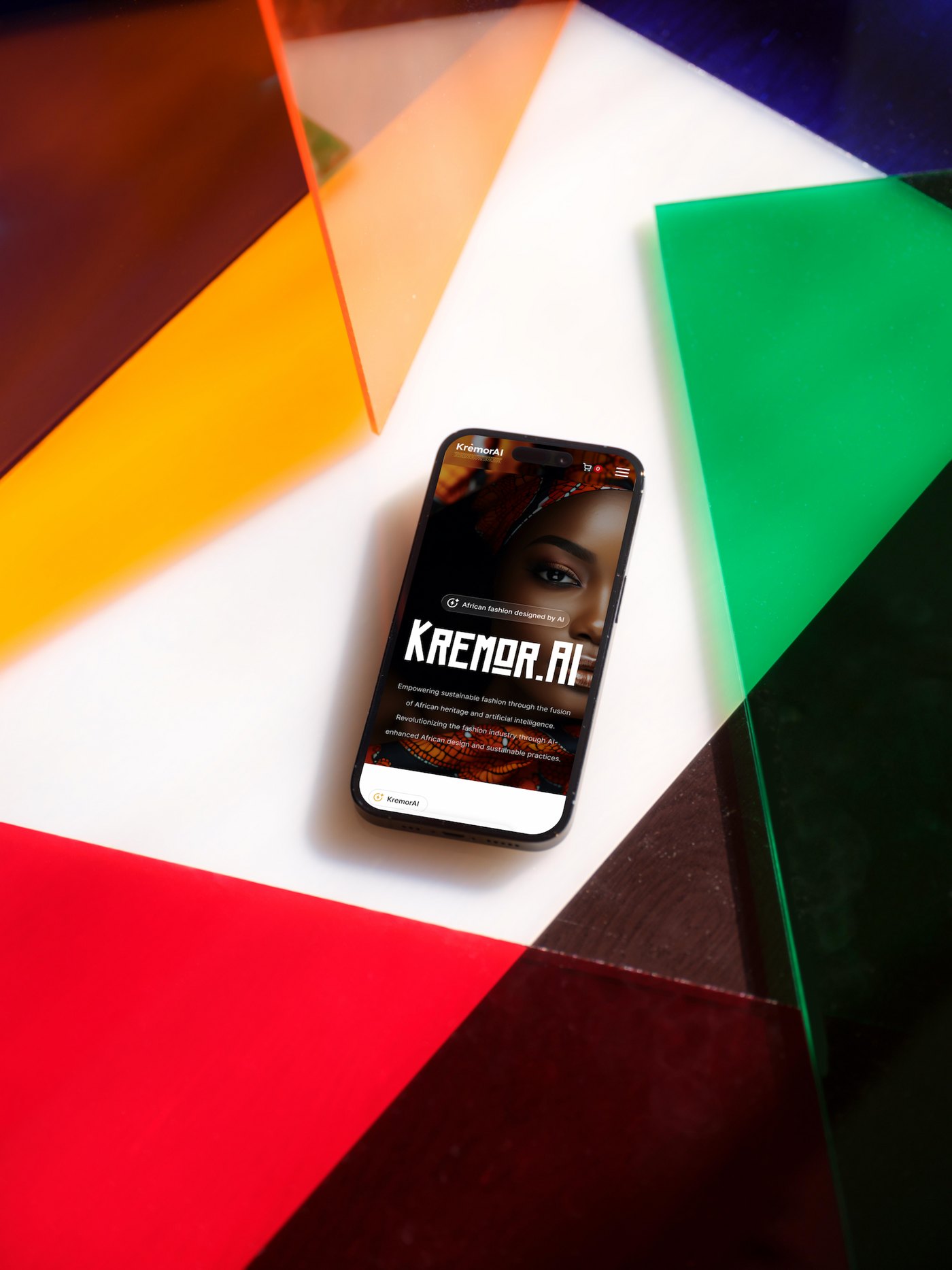
The storefront on a phone — the hero states the proposition in one line: African fashion designed by AI, sustainable, and rooted in heritage rather than borrowing from it 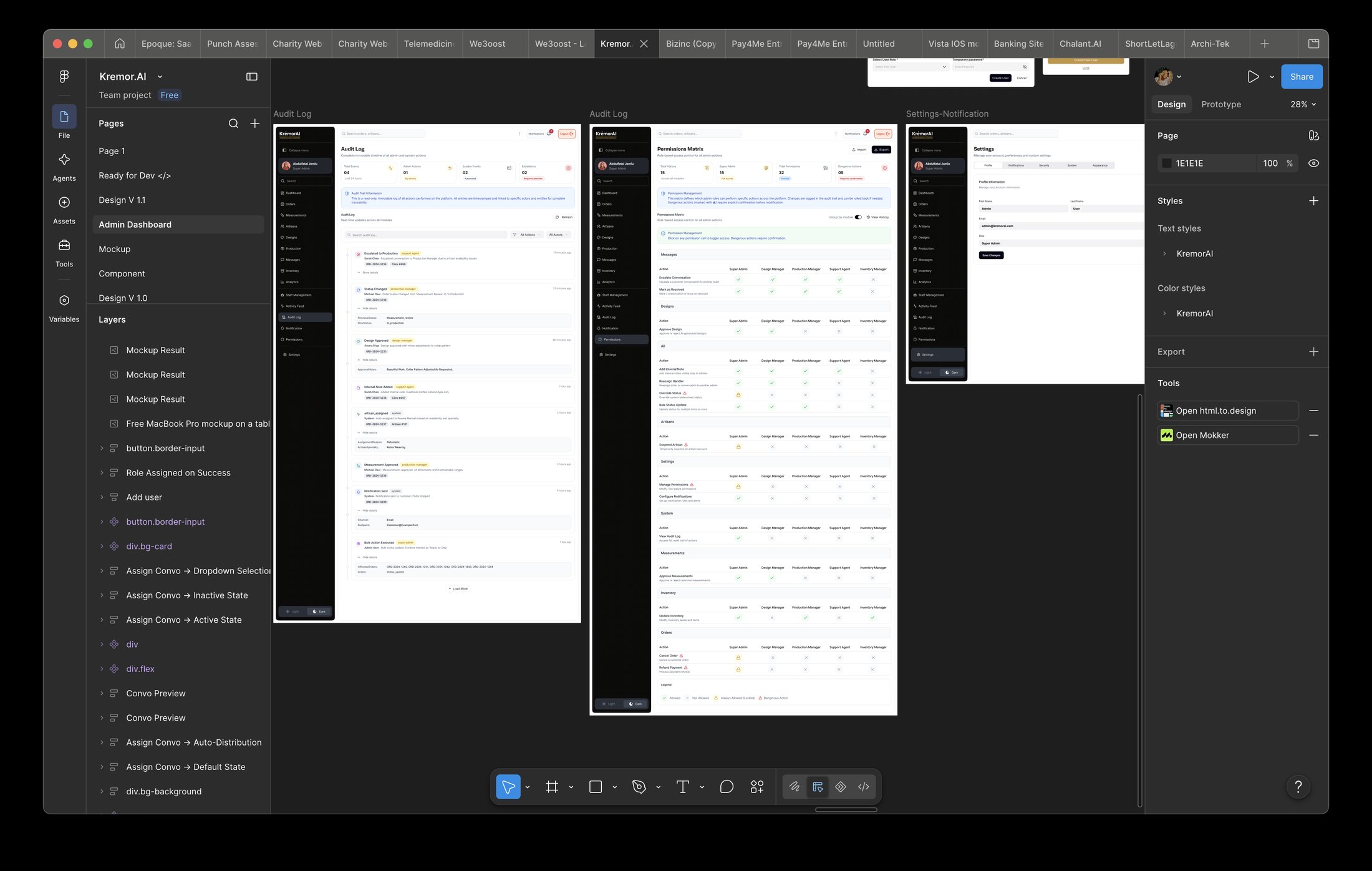
The accountability layer: an immutable audit log where every action is attributed to the role that took it, and a permissions matrix across Super Admin, Design Manager, Production Manager, Support Agent and Inventory Manager — with dangerous actions marked and locked permissions shown as locked 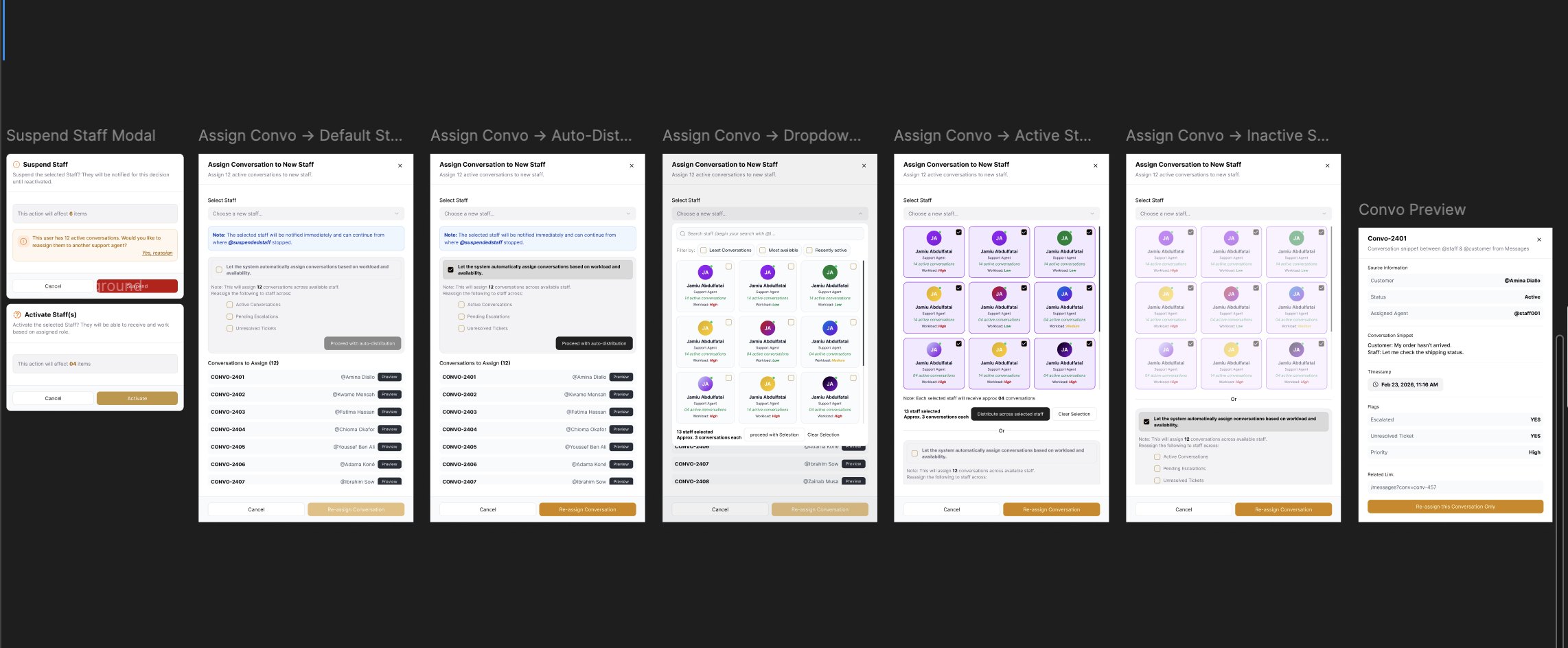
Reassigning work when a support agent is suspended: the modal raises their twelve open conversations first, then offers auto-distribution by workload or manual selection, with each agent's active conversation count and workload level visible before you choose 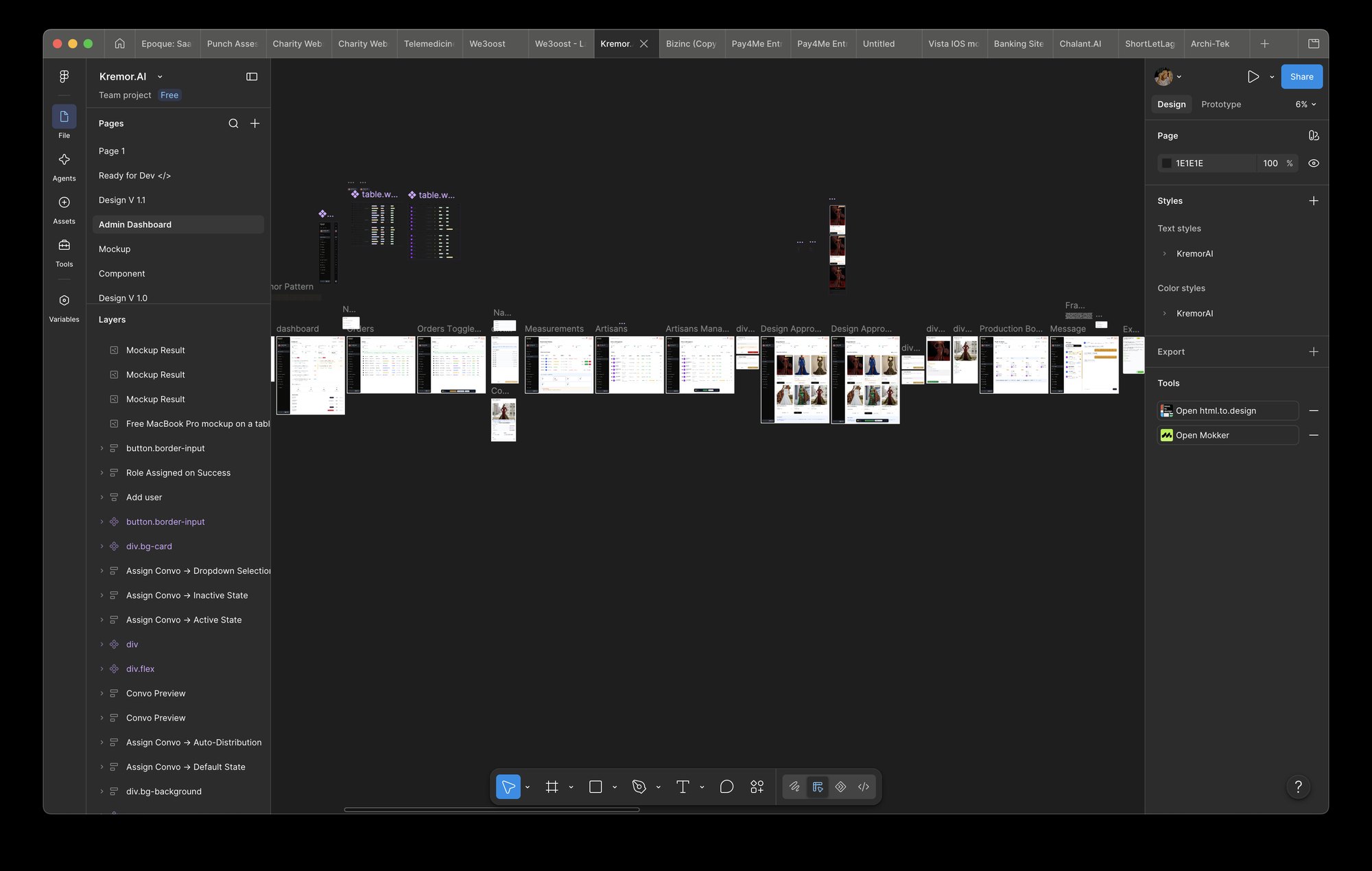
The admin dashboard laid out in the working Figma file — orders, measurements, artisans, design approvals, production board, messages and exports as one continuous pipeline, alongside the Ready for Dev and component pages